
Top Signs You Need Garage Door Service – Don’t Ignore These
The grinding noise your garage door has made for three months isn’t “just how it sounds.” It’s usually a worn roller that’s about to seize in a track, and in Dunedin’s heat that slide from annoyance to a door that won’t open takes roughly half the time it would in a cooler climate. The short answer: grinding, jerky travel, a door that drifts slowly, frayed cables, and uneven gaps at the bottom are all service signals. Ignore them and you’re generally choosing between a small repair and a much bigger one. If you’d rather not crawl around on a ladder guessing, call (877) 492-3256 and we’ll look at it.
What sounds mean what on a garage door?
Most “sudden” garage door failures in Dunedin had a warning noise attached to them for weeks. Learning to tell those sounds apart is the single most useful thing a homeowner can do, because each one points at a different part of the system and a different urgency level. You don’t need mechanical knowledge to recognize them. You just need to listen on the way out in the morning.
Here’s how we break down the three most common sound profiles:
- A grinding or scraping that follows the door the whole way up: usually a worn roller dragging in the track, or a bent track segment. This gets worse with heat, and it tends to announce itself before it seizes.
- A single sharp bang, then a door you can barely lift or a door that won’t move at all: that’s the classic sound of a torsion or extension spring breaking. This is the one that means stop operating the door. Springs hold the door’s weight under extreme tension, and once one fails the remaining hardware carries a load it was never meant to carry.
- A faint, scratchy whine or a caught, twanging feel along the side of the door: often a cable starting to fray at the drum or the bottom bracket. Frayed cable strands are sharp and unpredictable under tension, which puts them firmly in the professional-only category.
The reason sound matters so much here is climate. Dunedin’s warm months push metal to expand, grease to thin out, and rollers to wear faster than they would up north. Parts that would squeak along for a year somewhere cooler can move from squeak to failure in a season. Our technicians have up to 8 years of experience and have watched that clock run fast plenty of times.
Why is slow door movement the warning sign people miss most?
Slow movement is underestimated because nothing has broken yet, so it feels safe. It usually isn’t a minor quirk. A garage door that creeps up or drifts down has lost a fight it’s been losing quietly for a while, and three different components can be the cause. Identifying which one changes everything about how you handle it.
Here’s what’s typically behind a sluggish door:
- A weakening spring. The spring does the lifting so your opener doesn’t have to. As it loses tension, the door gets heavier and the opener labors to move it. This is a mechanical wear issue, not an adjustment you can tune away.
- A tired opener. A motor at the end of its life, or one with a stripped gear inside, will run but produce less pull. You’ll often hear it straining. Genie and LiftMaster units show this differently, which is why brand familiarity matters when we diagnose it.
- Friction in the tracks and hinges. Rollers that no longer spin freely, hinges that bind, or a track that’s slightly out of line all add drag. This one is the most fixable, and the most likely to cause secondary wear if you leave it.
A slow door in Dunedin is also more noticeable in summer, when the heat alone adds expansion and lubrication problems. If your door moved smoothly in January and feels like it’s wading through mud in July, don’t write it off as seasonal. Something is wearing, and slow travel is your early alert. If you’d rather have it checked than guess, call (877) 492-3256 for a free estimate.
What can you spot in a five-minute visual check?
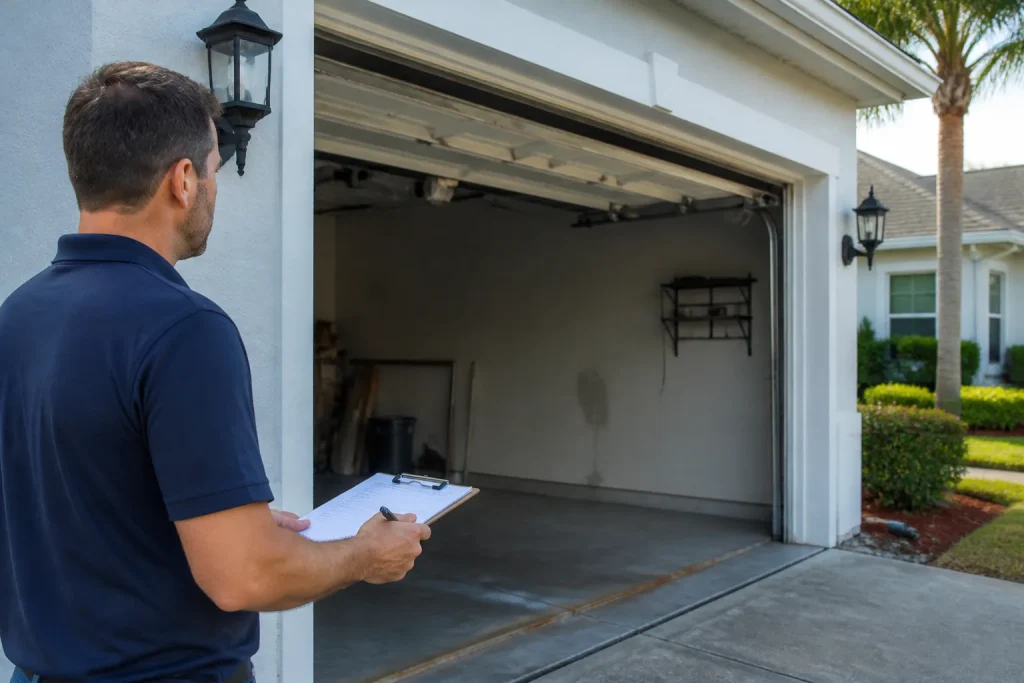
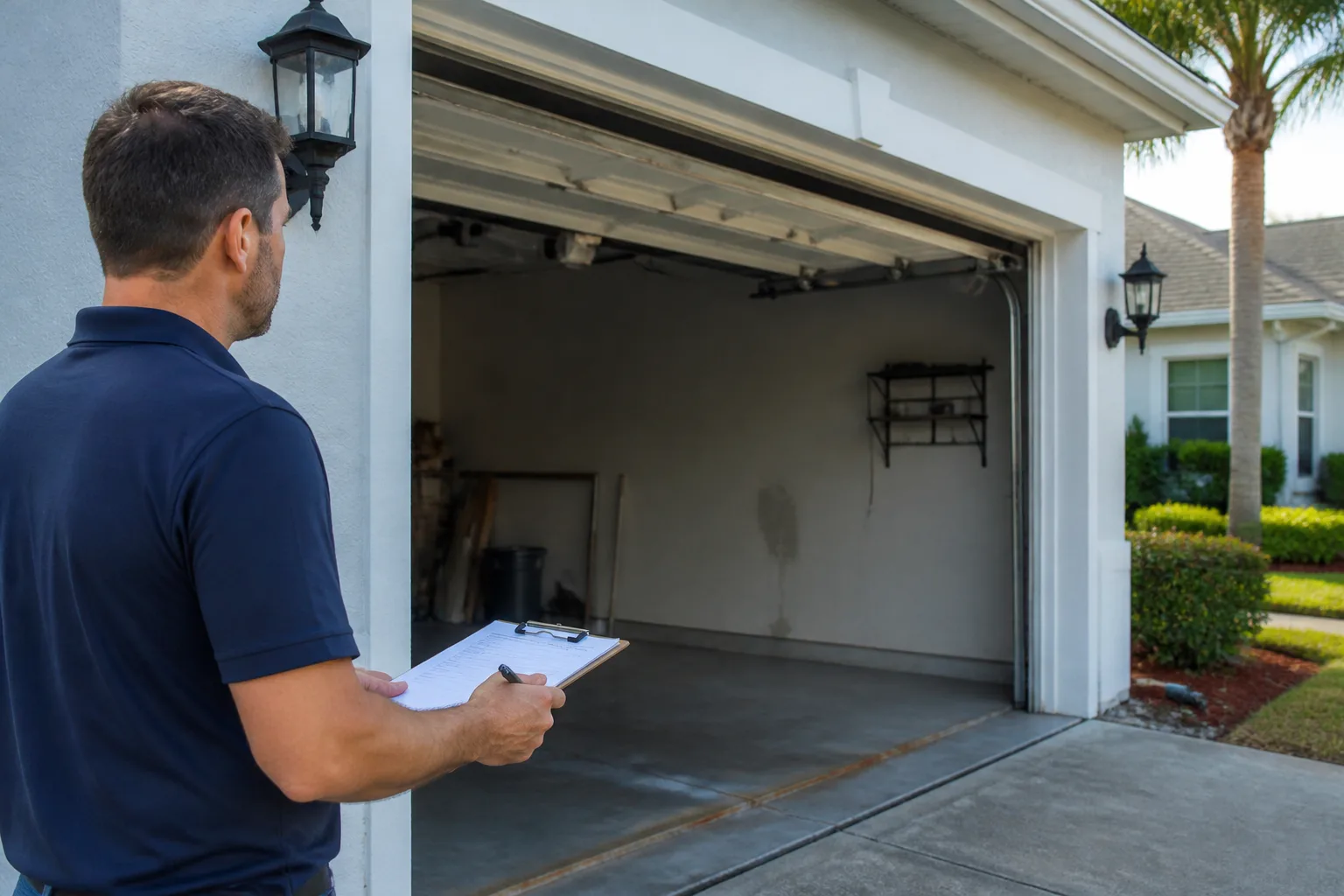
You can catch most of the serious stuff in under five minutes, standing in your garage, without touching any moving part. Three inspection points cover most of it: the cables, the bottom seal, and the gap between the rollers and the tracks. Here’s what “bad” actually looks like at each one, so you’re not staring at a perfectly normal door wondering if something’s wrong.
- Cables: run your eyes down each side. A healthy cable is a tight, uniform wind of strands. A failing one has fuzzy, frayed, or kinked sections, or strands sticking out at odd angles near the bottom corner. Look only. Never touch a cable under tension.
- Bottom seal: the rubber strip along the floor should sit flush and intact. Cracked, torn, or missing chunks let water and pests in and tell you the door’s been riding unevenly or hitting the floor at an angle. In Dunedin’s rainy stretches, a worn seal also means moisture where you don’t want it.
- Track gap: step back and look down each vertical track. The rollers should sit fully inside the channel with a consistent gap. A track that’s bent inward, dented, or visibly separated from its mounting points is a real find, and one that usually explains a grinding noise.
While you’re there, glance at the door’s horizontal line at the top. A door that sits visibly crooked, with one side higher than the other, points to a spring or cable imbalance. If your check turns up a frayed cable, a broken spring, or a bent track, close the door only if it’s safe to do so and leave it alone. That’s a professional call, and one we handle as a dedicated part of the trade.
Why does Dunedin’s temperature swing knock doors out of alignment?
Doors that were perfectly aligned in February can sit crooked by August, and not because anything was done wrong. Florida’s temperature swings between cooler winter months and hot, humid summers cause the door, the tracks, and the framing to expand and contract at slightly different rates. The result is a slow drift in alignment that stays invisible until the door suddenly binds, scrapes, or stops closing flush.
What makes this tricky is that alignment drift doesn’t announce itself. The door works fine, then it works fine but catches a little, then one day the opener reverses the door halfway down because it’s fighting resistance. It’s easy to blame the opener at that point, and easy to be wrong. A door that’s out of square puts extra load on the opener, the springs, and the hinges all at once, which is why we look at the whole system in Dunedin rather than just the part that made the noise.
You can watch for the visible clues. Look for daylight under one corner of the door when it’s down, a door that closes with one side meeting the floor before the other, or rollers that sit at visibly different heights side to side. Any of those is alignment drift showing up in plain sight. If you’re seeing it, a quick inspection is cheaper than waiting for it to become a bigger problem. Call (877) 492-3256 for a free estimate.
Which symptoms can you monitor, and which mean stop using the door?
Not every symptom needs the same response, and pretending otherwise is how people panic over a squeaky roller or ignore a snapped spring. The honest split is this: cosmetic issues and slow wear are safe to watch for a few days. Load-bearing or high-tension failures mean the door should stay closed and stay put until a technician arrives.
Safe to monitor for a few days:
- A single squeaky hinge or roller that still moves freely.
- An opener that’s a bit louder but still lifts the door smoothly and reverses correctly.
- A bottom seal with a small tear, as long as the door closes evenly.
Stop operating the door and call:
- Any broken spring, whether you heard the bang or just found the door too heavy to lift.
- A frayed or kinked cable.
- A door that’s visibly crooked or hanging off one side.
- A door that reverses on its own, closes unevenly, or won’t fully close.
- An opener that runs but the door doesn’t move at all.
Springs and cables are under extreme tension, and they’re the one part of a garage door that can injure a homeowner badly if handled wrong. Don’t try to loosen, adjust, or replace them yourself. That applies to a garage door spring repair just as much as it does to a full replacement. A door stuck open is also a security and weather problem, which is where emergency service comes in. We handle it as a real offering, not a marketing line.
When should you call a pro instead of watching it?
If you’ve listened, looked, and the door is grinding, drifting, crooked, or leaning hard against the opener, that’s the point to call. We make the call easy to act on. We work on any of the eight major brands, including Clopay, Amarr, Wayne Dalton, Genie, Chamberlain, LiftMaster, Craftsman, and Raynor, so we’re not guessing at your system’s quirks. We diagnose and repair in the same visit wherever possible. For information on that, see our garage door opener repair page, and if it’s a hardware or panel issue, our garage door repair page covers it.
We’re a single-trade specialist. Garage doors are the whole job, not a side service squeezed between other work. That matters when the diagnosis is a tired spring versus a worn roller versus a failing opener. The price is quoted and agreed before any work starts, and the written estimate is the final price. That’s the promise on every job in Dunedin, from a squeak to a full Garage Door Repair Dunedin call.
Related services in Dunedin: spring repair, opener repair, and full door installation are all in-house, so one call covers it. We’re also the one to call when the door traps your car or leaves the house open.
The Bottom Line
Almost every “sudden” garage door failure in Dunedin gave weeks of warning: a grinding roller, a slow door, a frayed cable, a crooked line. The three habits that save you the most money are simple. Listen for the sound profiles. Watch for slow travel. Do the five-minute visual check on cables, seal, and track gap. Then act on what you find, and keep your hands well away from springs and cables, which are the two things on a garage door that should never be a DIY job.
If you’d rather have a trained eye look, we can help. If you’re in Dunedin and need help, Garage Door Repair Dunedin offers free estimates – call (877) 492-3256. We answer 24/7. Fast dispatch from 7am to 7pm, Sunday through Friday.
Frequently Asked Questions
The earliest signs are usually sound and speed: grinding or scraping as the door travels, a door that moves slower than it used to, and a single loud bang followed by a door that’s hard to lift. Visibly frayed cables, a crooked door line, and uneven gaps at the floor are visual signs to check within minutes. Call (877) 492-3256 for an exact quote – estimates are free.
Yes, for urgent problems like a broken spring or a door stuck open, we offer same-day service. We answer 24/7. Fast dispatch from 7am to 7pm, Sunday through Friday. A call outside dispatch hours is booked into the next opening. Call (877) 492-3256 to get scheduled.
No. The price is quoted and agreed before any work starts, and the written estimate is what you pay. If we find something on arrival that changes the diagnosis, we tell you and re-quote before touching anything, so there are no surprises. Call (877) 492-3256 for a free estimate.
The technicians we connect you with are working professionals who handle that side as their state requires. Our technicians have up to 8 years of experience and work on garage doors exclusively, including brands like Clopay, Amarr, Wayne Dalton, Genie, and the rest of the eight major lines we’re familiar with. Call (877) 492-3256 for a free estimate.
Written by the team at Garage Door Repair Dunedin.
Need Garage Door Help?
Call Garage Door Repair Dunedin - the local pro we connect you with is licensed and insured, here with fast help in Dunedin.
(877) 492-3256