
Emergency Garage Door Repair Near Me: What Dunedin Homeowners Should Do First
If your garage door fails and your car is trapped inside, the instinct to yank the emergency release cord is exactly right, unless the spring is broken. In that case, pulling that cord can drop a 150-pound door without warning. The first fifteen minutes after a garage door emergency are where most Dunedin homeowners accidentally make the damage worse or leave their home exposed. This is the calm, step-by-step sequence to follow before you call anyone.
If you’d rather not work through a checklist in the middle of a bad morning, call (877) 492-3256. We answer 24/7. Fast dispatch from 7am to 7pm, Sunday through Friday.
Start Here: The First Three Things to Do When Your Door Fails
The order matters more than the speed. Before you touch anything, figure out what actually failed. Most garage door emergencies in Dunedin fall into one of three categories: a snapped torsion or extension spring, a door stuck partway on a bent track, or an opener that has quit while the door itself is fine.
Work through these three steps in order:
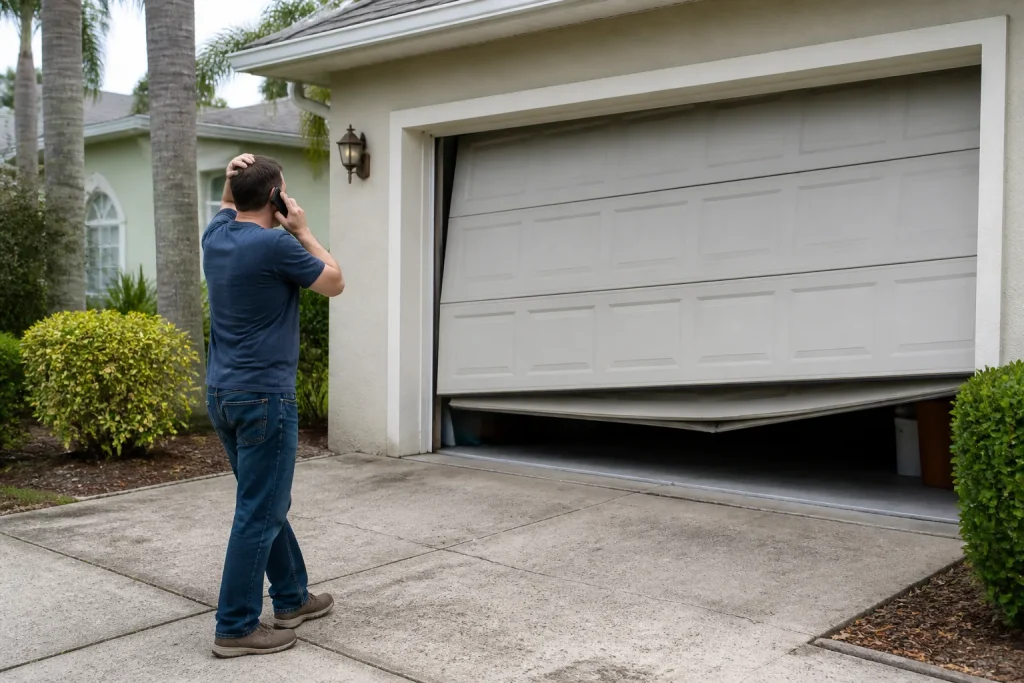
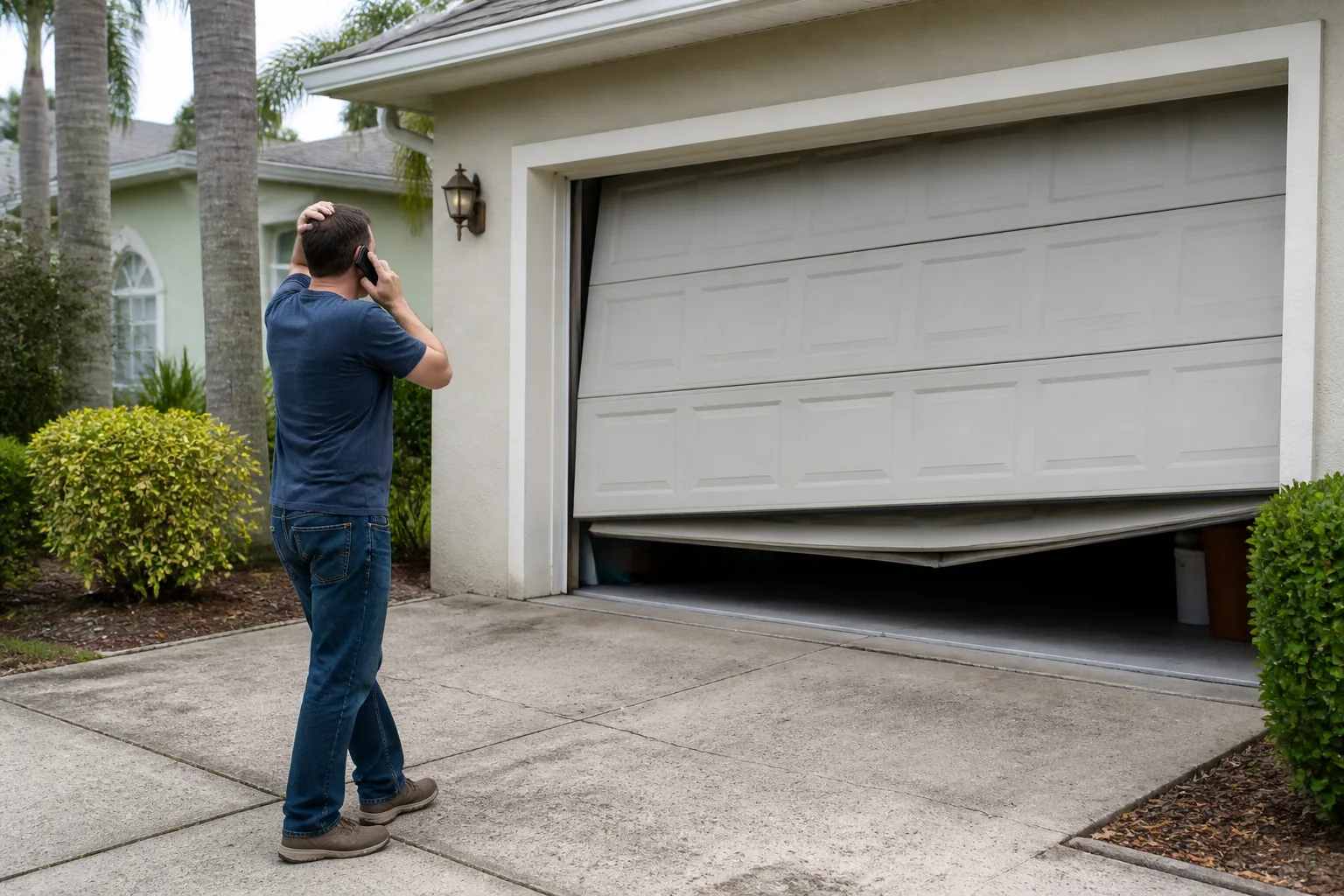
- Step back and listen, then look. A loud bang from the garage usually means a spring broke. A grinding opener sounds different. A door hanging crooked on one side points to a track or cable problem. Knowing which one you’re looking at changes everything that follows.
- Don’t force the door by hand. If the door feels unusually heavy or won’t lift smoothly, stop. A door with a broken spring can weigh well over a hundred pounds and trying to lift it risks injury and can bend panels and tracks that were fine before.
- Leave the door where it is and secure the space around it. We’ll get to that in the next section.
One quick note on the opener: if the door is stuck and the motor keeps running, unplug the opener from the wall outlet so it doesn’t burn itself out cycling against a door that can’t move. That’s the one thing you can safely do yourself.
The Emergency Release Cord: When to Pull It and When to Leave It Alone
Here’s the rule in one sentence: pull the emergency release cord only if the door is fully closed and the spring is intact. If the spring is broken, that cord is the worst thing you can touch.
The release cord disconnects the door from the opener so you can move it by hand. That’s a useful feature when the power is out or the motor has died. But the moment the release disengages, the door’s full weight is unsupported by the opener. With a working spring, the door is balanced and easy to lift. Without one, gravity does whatever it wants. A door that drops suddenly can crush a foot, break a wrist, or slam down hard enough to destroy panels and track. It’s genuinely one of the few places in a home where a single pull can cause real injury.
How to tell whether it’s safe:
- Spring intact, door fully closed, just a dead opener? The release cord is fine to pull. Lift the door slowly by hand, and don’t let go until it’s up.
- You heard a bang or the door looks crooked? Don’t touch the cord. Call for help and keep everyone, kids and pets included, away from the door.
- Door stuck partway up or down? Don’t pull the release. A partially open door under tension is unpredictable, and releasing it can send it falling.
This is why garage door spring repair is its own discipline. Springs, cables, and the brackets that hold them under tension are the highest-risk parts on any door, and a trained technician works with the right tools and the door secured before anything is released.
How to Secure a Partly Open Garage Door While You Wait
A door that won’t close all the way leaves your home open to anyone who walks or drives past. In Dunedin, the risk is real: an unsecured garage is an easy target and a common way homes get entered, especially when a door is left up overnight or for hours in a quiet neighborhood. Securing the opening while you wait is worth ten minutes of effort.
What actually works, in rough order of effort:
- Park a vehicle close to the inside of the opening. Blocking the gap from inside stops anyone from walking in. For a small gap, backing a car up against the door is the fastest fix.
- Brace the door from inside with a sturdy bar or ladder laid across the opening. This keeps a sagging door from dropping further and makes the gap hard to pass. Skip anything flimsy.
- Move valuables and anything with tools or a garage door opener in it out of sight. If the door stays up for a while, don’t leave the spare opener clipped to the visor or the tool cart visible.
- Tell a neighbor. In Dunedin’s tighter residential blocks, a neighbor who knows your door is broken and glances at your driveway through the afternoon is a real deterrent. Simple as that.
If the door is up and won’t come down at all, don’t attempt to lower it in the dark or on your own. A door that’s stuck under tension can come down hard and fast. That’s the point to have someone on the way.
What to Have Ready When You Call for Emergency Repair
A good emergency call takes about two minutes if you have the details handy, and it lets the technician arrive with the right parts instead of making a second trip. Here’s the short list to have ready before you dial:
- The make of your door and opener. This matters more than people realize. Different brands fail in different ways and take different parts. We’re certified to service eight major brands, including LiftMaster, Chamberlain, Genie, Clopay, Amarr, Wayne Dalton, Craftsman, and Raynor, so when you tell us it’s a Wayne Dalton door with a Craftsman opener, we know the setup before we arrive.
- What you heard and what you see. Did it bang, grind, or just stop? Is the door crooked, fully down, fully up, or stuck halfway?
- Whether a car is trapped inside. Say so up front. It changes the urgency and helps the technician plan.
- Whether the door is currently secure. Up, down, or partly open. If it’s open, say what you’ve done to block it.
- Whether you’ve tried the release cord or the wall switch. No judgment here, but we don’t want to guess at what’s already been tried. This goes double for spring failures, where the answer tells us a lot.
On the topic of who to call: a true emergency service is one where someone answers when you call and books a technician, not a call-forwarding service that takes your number and promises to “get back to you.” Ask straight out whether they can get a technician out, and how soon.
If the problem turns out to be the opener rather than the door, that’s a same visit diagnosis too, and garage door opener repair covers the motor, the wall switch, the safety sensors, and the remotes that stop responding.
Storm and Wind Scenarios in Dunedin: What to Check First
Dunedin’s weather swings between long dry stretches and fast-moving storms, and a surprising share of garage door emergencies start with wind rather than a worn part. A gust strong enough to flex a door can lift a panel out of its track, twist a hinge, or shove debris into the rails. Before you assume something structural is wrong, check these first:
- Look at the track, not the panel, first. A panel that looks bent is often just riding outside a track that’s been knocked slightly out of alignment. That’s a repair, not a replacement.
- Check the bottom seal and the edges of the opening. Debris tends to collect there and can stop a door from closing fully, which is usually why it won’t seal after a storm.
- Look for anything the wind carried against the door. A branch leaning on a panel can make a door jam without the door being damaged at all.
- Test the opener only after the door is clear. If the door moves freely by hand, then see if the opener still runs.
If a panel did come out of the track or the door is hanging unevenly, leave it. Twisted track and a door that’s off its rollers can fail suddenly, and getting it back onto the rails safely is a two-person job with the door secured. That’s when to call a pro rather than improvise.
Related services in Dunedin
Whether it’s a snapped spring or a door that needs replacing, garage door repair covers the everyday fixes, and when a door is beyond repair, Garage Door Repair Dunedin handles installation and replacement with a free measure and a written price before anything is ordered.
What happens when you call
- 1
A real person answersNo phone trees – you reach a local pro.
- 2
You get an upfront price rangeHonest numbers before anyone is dispatched.
- 3
A background-checked tech heads outLicensed & insured, dispatched right away.
- 4
You approve before work beginsNothing starts until you say go.
The Bottom Line
The fifteen minutes after a garage door fails are about three things: don’t force the door, don’t pull the release cord if a spring is broken, and secure the opening while you wait. Have your door and opener make ready when you call, and ask whoever answers whether they can actually get a technician out. Those few steps protect your home and make the repair faster.
Our technicians have up to 8 years of experience, we’re certified to service eight leading brands, and every job is a garage door job, not a side service. In our experience, a clear report on what you’re hearing and seeing is worth more than anything else you can give us when you call.
If you’re in Dunedin and need help, Garage Door Repair Dunedin offers free estimates. Call (877) 492-3256. We answer 24/7. Fast dispatch from 7am to 7pm, Sunday through Friday. The price is quoted and agreed before any work starts, so there are no surprises on the invoice.
Frequently Asked Questions
Don’t force it. Check whether the opener is running and whether the door looks crooked. If you hear a bang or the door is heavy, assume a broken spring and keep everyone away from it. If everything looks normal and it’s just a dead opener with the door fully closed, it’s safe to pull the release cord and lift the door by hand. Call (877) 492-3256 for an exact quote, estimates are free.
No. With a broken spring, the door has no counterbalance and its full weight is hanging on the opener and the track. Pulling the release cord can let a 150-pound door drop without warning and cause serious injury. Leave the cord alone and call for a technician. Call (877) 492-3256 for help.
A broken spring usually announces itself with a loud bang, and the door becomes too heavy to lift by hand. A broken opener is the opposite: the motor hums or clicks but the door doesn’t move, or the door is easy to lift by hand while the opener won’t run. If you’re not sure, that’s exactly what the technician diagnoses on the first visit. Call (877) 492-3256.
The written estimate is the price. We quote and agree on the work before anything starts, and the written estimate sets the final cost. If the diagnosis turns up something different once the door is inspected, we’ll tell you and get your agreement before any extra work. Call (877) 492-3256 for a free estimate.
Written by the team at Garage Door Repair Dunedin.
Need Garage Door Help?
Call Garage Door Repair Dunedin - the local pro we connect you with is licensed and insured, here with fast help in Dunedin.
(877) 492-3256